Introduction
Organisations are racing to deploy AI agents, Microsoft 365 Copilot, ChatGPT Enterprise and autonomous workflows. Yet many are discovering a fundamental challenge:
AI can only be as trustworthy as the data it can access.
Poor visibility, weak governance and limited evidence create AI systems that expose sensitive information, generate unreliable responses and increase organisational risk.
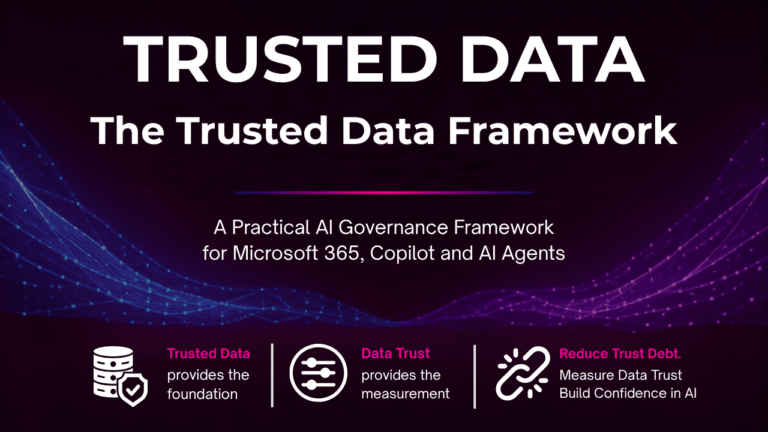
The Trusted Data Framework provides a practical methodology for building trustworthy enterprise data that enables AI to operate securely, reliably and at scale.
Artificial intelligence rarely creates enterprise data governance problems. Instead, it exposes what already exists. We call this Trust Debt: the accumulation of hidden governance gaps that reduce confidence in organisational data and increase risk.
Every over-permissioned SharePoint site, unlabelled document, unmanaged workspace and unsecured AI agent contributes to that Trust Debt. AI can discover and use this information in seconds, making long-standing governance issues visible at the speed of a prompt.
Reducing Trust Debt is therefore not simply an AI initiative. It is a data governance strategy that builds the trusted foundation required for AI, autonomous agents and modern digital workplaces.
Key Takeaways
- Copilot does not create Trust Debt. It reveals it.
- Trusted Data is the foundation for successful AI adoption in Microsoft 365, Copilot and AI Agents; and Data Trust is how you measure it.
- Data Trust = Visibility × Governance × Evidence.
- The Trusted Data Framework helps organisations build a governed, secure and measurable data estate.
- Organisations improve trust through a continuous cycle of See • Shape • Prove.
The AI Governance Challenge
Microsoft 365 Copilot and AI Agents work using the permissions, content and controls that already exist within your Microsoft 365 estate.
If your data estate is not well governed, AI can amplify existing problems such as:
- Oversharing of sensitive data
- Excessive permissions
- Unmanaged AI usage
- Shadow AI
- Compliance and regulatory risk
For years, these issues often remained hidden because employees typically accessed only the information they knew existed. AI changes that.
A single prompt can retrieve and summarise information from thousands of locations in seconds, using the permissions that already exist.
The challenge is therefore not simply governing AI.
The challenge is governing the data that AI can already reach.
This is where Trusted Data becomes essential.
To use Microsoft 365 Copilot and AI Agents with confidence, organisations must understand their data, govern access appropriately and demonstrate that controls are operating effectively.
Successful AI adoption starts with Trusted Data.
What is Trusted Data?
Trusted Data is data that is visible, governed and supported by evidence, enabling organisations to adopt Microsoft 365 Copilot and AI Agents with confidence.
Rather than assuming data is secure, accessible and compliant, Trusted Data requires those qualities to be measured, governed and continuously validated.
In a Microsoft 365 environment, Trusted Data means:
- Sensitive information can be discovered and understood.
- Access is controlled through appropriate permissions and governance policies.
- Security and compliance controls are applied consistently.
- AI experiences operate against data that has been reviewed, protected and governed.
- Governance decisions are supported by measurable evidence rather than assumptions.
Trusted Data is not a product or technology. It is an outcome.
The Trusted Data Framework provides the methodology for building Trusted Data, while Data Trust is the measurable outcome.
Put simply:
You build Trusted Data to earn Data Trust.
As organisations increase visibility, strengthen governance and collect evidence that controls are working, trust becomes measurable. That measurement can then be used to drive AI readiness, reduce risk and support the responsible adoption of Microsoft 365 Copilot and AI Agents.
Unfortunately, many organisations begin their AI journey with years of accumulated governance gaps, excessive permissions and unmanaged data. This accumulated risk is what the Trusted Data Framework calls Trust Debt.
What is Trust Debt?
Trust Debt is the accumulation of governance gaps, unmanaged data and excessive access that increase organisational risk over time.
Like technical debt, Trust Debt often develops gradually. As organisations create new SharePoint sites, Teams workspaces, OneDrive files and AI agents, permissions expand, content grows and governance becomes increasingly difficult to maintain. Without ongoing oversight, the gap between how data should be governed and how it is governed continues to widen.
Trust Debt can include:
- Overshared SharePoint sites and Microsoft Teams
- Excessive or outdated permissions
- Unlabelled or unclassified sensitive information
- Stale workspaces and inactive content
- Unmanaged external sharing
- Shadow AI and unauthorised AI usage
- AI agents with excessive permissions or insufficient governance
- Missing evidence that security and compliance controls are operating effectively
For many organisations, these issues remain largely invisible because users typically access only the information they know exists.
Microsoft 365 Copilot and AI agents change that. They can discover and retrieve information from across the Microsoft 365 estate using the permissions that already exist. As a result, long-standing governance weaknesses become visible in seconds.
Copilot does not create Trust Debt. It reveals it.
Reducing Trust Debt requires more than deploying new security tools. It requires organisations to improve visibility, strengthen governance and continuously demonstrate that controls are operating effectively.
The Trusted Data Framework provides a practical methodology for achieving this. By increasing Visibility, strengthening Governance and providing measurable Evidence, organisations can build Trusted Data, increase Data Trust and reduce Trust Debt, creating a secure foundation for Microsoft 365 Copilot and AI Agents.
The Trusted Data Framework
The Trusted Data Framework is a practical methodology for governing enterprise data, Microsoft 365, Copilot and AI Agents. It provides organisations with a structured approach to reducing Trust Debt, building Trusted Data and measuring progress through Data Trust.
Rather than focusing on AI technologies in isolation, the framework recognises that successful AI adoption depends on the quality, governance and trustworthiness of the underlying data estate. It connects business strategy with operational governance and measurable assurance, helping organisations move from reactive risk management to continuous AI governance.
The framework consists of four interconnected layers.
| Layer | Key Question | Purpose |
|---|---|---|
| Intent | Why are we using AI and where should we not use it? | Define business objectives, acceptable use and governance principles. |
| Practice | How do we operate AI safely and responsibly? | Establish policies, processes, security controls and operational governance. |
| Foundation | What data can AI access and trust? | Build Trusted Data through visibility, governance and protection across Microsoft 365. |
| Measurement | How do we demonstrate governance and control? | Provide measurable evidence, reporting and continuous assurance. |
Together, these layers ensure that AI governance is aligned with business objectives, operational processes and measurable outcomes.
Data Trust = Visibility × Governance × Evidence
At the heart of the framework is a simple equation.
Data Trust = Visibility × Governance × Evidence
Data Trust is not based on opinion or assumptions. It is the measurable outcome of three interconnected capabilities working together.
Visibility
Visibility answers a fundamental question:
What does AI know about your organisation?
Organisations must understand where sensitive information exists, who has access to it, how data is shared and which AI applications and agents can interact with it. Without visibility, governance decisions are based on assumptions rather than facts.
Governance
Governance determines how information should be protected.
It establishes the policies, permissions, lifecycle management, security controls and compliance requirements that ensure AI operates within organisational boundaries. Effective governance reduces Trust Debt by limiting unnecessary exposure and applying consistent guardrails across Microsoft 365.
Evidence
Evidence demonstrates that governance is working.
Dashboards, reporting, audit logs, compliance assessments and measurable security outcomes provide confidence that policies are operating as intended. Evidence transforms governance from aspiration into assurance.
Because the equation is multiplicative, weaknesses have a significant impact on overall trust.
If Visibility is low, organisations cannot govern what they cannot see.
If Governance is weak, visibility alone cannot reduce risk.
If Evidence is missing, organisations cannot demonstrate compliance or continuous improvement.
Trusted AI depends on all three.
See • Shape • Prove
The Trusted Data Framework is implemented through a continuous operational cycle called See • Shape • Prove.
Rather than treating governance as a one-time project, this model supports continuous improvement as organisational data, users and AI capabilities evolve.
See
Discover and understand the current state of your Microsoft 365 environment.
Identify sensitive information, excessive permissions, oversharing, unmanaged workspaces, AI exposure and emerging governance risks. Visibility provides the evidence needed to make informed governance decisions.
Shape
Reduce Trust Debt by applying governance.
Implement information protection, permissions management, lifecycle controls, AI guardrails and operational processes that improve the quality and trustworthiness of enterprise data.
Prove
Demonstrate measurable governance.
Use reporting, audit, compliance monitoring and security metrics to provide evidence that controls are operating effectively. Measuring Data Trust enables organisations to track progress, demonstrate compliance and continuously improve their AI governance maturity.
The See • Shape • Prove cycle repeats continuously as new data, users, workloads and AI agents are introduced.
What Trusted Data Delivers
Organisations that adopt the Trusted Data Framework can:
- Govern Microsoft 365 Copilot and AI Agents with confidence.
- Reduce oversharing and unnecessary access to sensitive information.
- Improve data security, privacy and regulatory compliance.
- Establish repeatable and sustainable AI governance practices.
- Measure AI readiness using objective evidence rather than assumptions.
- Increase confidence among business leaders, security teams and regulators.
- Create a scalable foundation for future AI initiatives.
Most importantly, organisations replace reactive governance with a continuous process that builds Trusted Data, reduces Trust Debt and increases Data Trust over time.
Frequently Asked Questions
The following questions are commonly asked by organisations preparing for Microsoft 365 Copilot and AI Agent adoption.
What is Trusted Data?
Trusted Data is data that is visible, governed and supported by evidence, enabling organisations to use Microsoft 365 Copilot and AI Agents with confidence.
What is Data Trust?
Data Trust is the measurable outcome of Visibility, Governance and Evidence working together. It provides an objective way to assess the readiness of your data estate for AI.
What is Trust Debt?
Trust Debt is the accumulation of governance gaps, excessive permissions, unmanaged data and insufficient evidence that increase organisational risk. Microsoft 365 Copilot does not create Trust Debt; it reveals it.
How does the Trusted Data Framework help?
The Trusted Data Framework provides a structured methodology for reducing Trust Debt, building Trusted Data and measuring governance maturity through Data Trust.
Why is Microsoft Purview important for AI governance?
Microsoft Purview provides many of the visibility, information protection, data security and compliance capabilities needed to implement the Trusted Data Framework. Together with Microsoft Entra, Microsoft Defender, Microsoft Fabric and Microsoft 365, it helps organisations build a secure and governed data estate for AI.
How do you govern Microsoft 365 Copilot?
Successful Copilot governance begins with Trusted Data. Organisations should improve visibility into their data, apply consistent governance controls and continuously measure outcomes through evidence. The Trusted Data Framework provides a practical approach for achieving this.
Start Building Trusted Data
Artificial intelligence is only as trustworthy as the data it can access.
The Trusted Data Framework helps organisations reduce Trust Debt, build Trusted Data and measure Data Trust, creating a secure and governed foundation for Microsoft 365 Copilot and AI Agents.
Whether you are preparing for Microsoft 365 Copilot, securing AI Agents or strengthening Microsoft Purview governance, the journey begins with Trusted Data.
TRUSTED AI STARTS WITH TRUSTED DATA
Trust Debt is the risk to reduce
Trusted Data provides the foundation
Data Trust provides the measurement
The Trusted Data Framework provides the methodology
The Trusted Data Framework™ is an original methodology developed by Nikki Chapple.