Shadow AI governance is now a critical challenge for organisations.
Shadow AI is already inside your organisation.
Employees are using AI tools every day to summarise documents, improve emails, analyse spreadsheets, generate presentations, and draft proposals. Most are not trying to break policy. They are trying to work faster and smarter.
That is exactly what makes Shadow AI such a serious governance risk.
This is no longer a question of whether AI is being used at work. It is a question of whether your organisation has visibility into which AI tools are in use, what data is being shared, and which controls are in place to reduce risk.
The urgency is real. Microsoft’s 2026 Data Security Index report says that 32% of surveyed organisations’ data security incidents involve the use of generative AI tools, while only 47% of surveyed organisations are implementing controls focused on generative AI workloads. More than 80% of surveyed organisations are implementing or developing Data Security Posture Management strategies to improve visibility and governance.
AI adoption is accelerating.
Governance is still catching up.
This article explains the practical control model I use with organisations to understand Shadow AI risk, improve visibility, and apply effective governance at scale.
Table of Contents
What is Shadow AI?
Shadow AI is the use of AI tools, especially generative AI tools, without the knowledge, approval, or governance of an organisation’s IT or security teams.
Microsoft describes Shadow AI as a significant challenge because the unregulated use of AI tools can lead to data leaks, noncompliance with regulations, and reputational harm. See Prevent data leak to shadow AI
In practice, Shadow AI usually looks like this:
- A user pastes sensitive text into a public chatbot
- A contract is uploaded to an AI assistant for summarisation
- Internal financial data is copied into a generative AI tool from a personal browser session
- A presentation is drafted using content that should never have left the tenant
None of this requires malicious intent. It only requires convenience, curiosity, and lack of control.
Why Shadow AI Governance Matters Now
Shadow AI introduces three immediate risks.
1. Data leakage
Sensitive information can leave your organisation through unmanaged AI tools the moment a prompt is submitted.
2. Compliance gaps
Regulatory and contractual obligations may be breached without any visibility or audit trail.
3. Loss of control
If you cannot see how AI is being used, you cannot govern it.
This is not theoretical.
According to Microsoft’s 2026 Data Security Index, 32% of data security incidents already involve generative AI tools, and fewer than half of organisations have implemented controls.
The gap is clear.
AI is already embedded in daily work. Governance is still catching up.
Shadow AI Is Already Mainstream
This is not a future problem. It is happening today.
Employees are already using AI to:
- Summarise documents
- Improve emails
- Analyse spreadsheets
- Generate presentations
- Draft proposals
Most users are not malicious.
In many cases, the underlying issue is not the AI tool itself, but the state of the data. If your organisation has not addressed oversharing or data governance, AI will simply surface that risk faster. I cover this in more detail in my guide on Microsoft 365 Copilot data readiness.
They are simply moving faster than your policies.
That is the challenge.
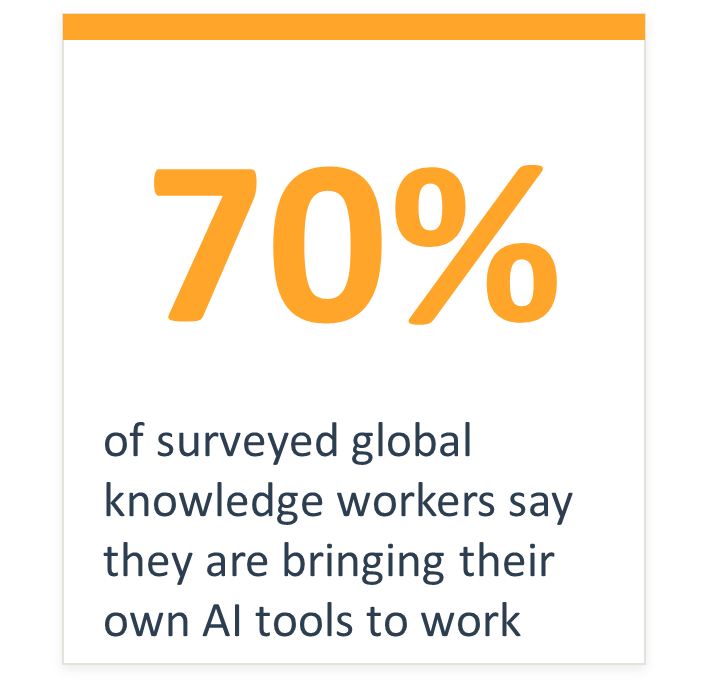
Source 2026 Data Security Index: Unifying Data Protection and AI Innovation | Microsoft Security
Shadow AI Is Not a Technology Problem
This is where most organisations get it wrong.
Shadow AI is not a technology problem. It is a mismatch between what users need and what organisations have governed.
Users are adopting AI because it is fast, accessible, and effective. When governed alternatives are not available, they will naturally turn to unmanaged tools to get their work done.
This is why blocking alone does not work.
Blocking does not remove demand. It simply pushes activity into places you cannot see, making the problem more difficult to control rather than reducing it.
The organisations that succeed take a different approach.
They do not try to eliminate Shadow AI. Instead, they focus on replacing unmanaged usage with governed, approved, and visible alternatives.
This is the shift that matters.
Shadow AI is not something you block.
It is something you govern.
This is also why many organisations underestimate the role of governance in existing Microsoft 365 environments. If access is too broad, AI will surface too much. I explore this further in Container Sensitivity Labels: The Purview “Hack” That Fixes Copilot Oversharing Fast, where the root cause of oversharing is often the collaboration model itself.
Why Shadow AI Is Different from Shadow IT
Many organisations initially treat Shadow AI as another form of Shadow IT.
That is a mistake.
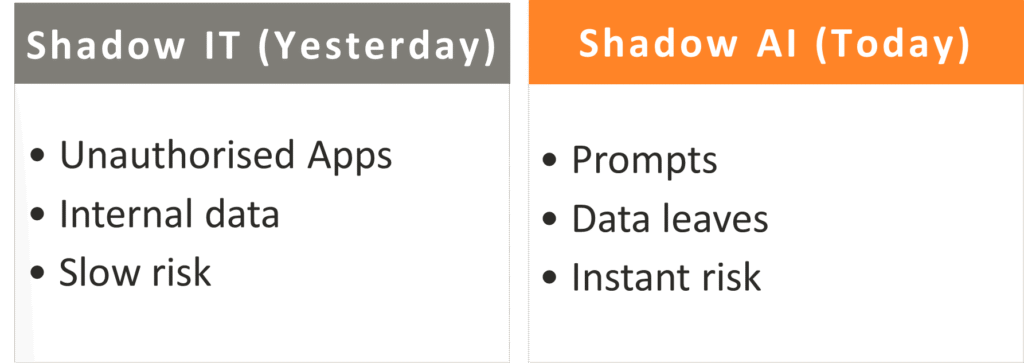
| Shadow IT | Shadow AI |
|---|---|
| Applications adopted over time | AI prompts submitted instantly |
| Data moves gradually | Data leaves immediately |
| Risk increases over time | Risk occurs in real time |
With Shadow AI, the moment a prompt is submitted, the data has already left your control.
This is a different risk model. It requires a different approach.
How Organisations Actually Discover Shadow AI
Shadow AI is rarely discovered through a security alert.
It usually starts with a simple question.
“Are people putting sensitive data into AI tools?”
At that point, most organisations do not have an answer.
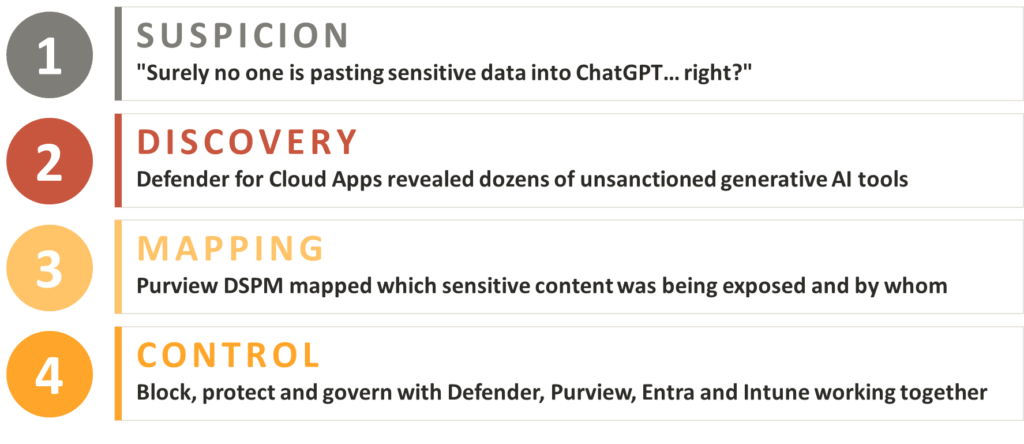
The pattern that follows is consistent.
The suspicion
Leadership assumes usage is limited and low risk.
The discovery
Defender for Cloud Apps reveals widespread use of unsanctioned AI tools.
The mapping
Purview Data Security Posture Management identifies where sensitive data is exposed.
The realisation
The risk is not theoretical. It is already happening.
This is the moment most organisations see reality for the first time.
What they assumed was occasional usage is actually widespread, daily, and ungoverned.
Discovery is not the outcome.
It is the starting point.
To move beyond discovery, organisations need to measure how AI usage and risk evolve over time. I explore this further in Measuring Copilot and Generative AI Success and Risks.
A Practical Control Model for Shadow AI
Most organisations respond to Shadow AI reactively.
That does not scale.
The Microsoft Purview Deployment Model: Prevent data leak to shadow AI recommends a four-step approach for governing Shadow AI:
- Discover
- Assess
- Control apps
- Control data
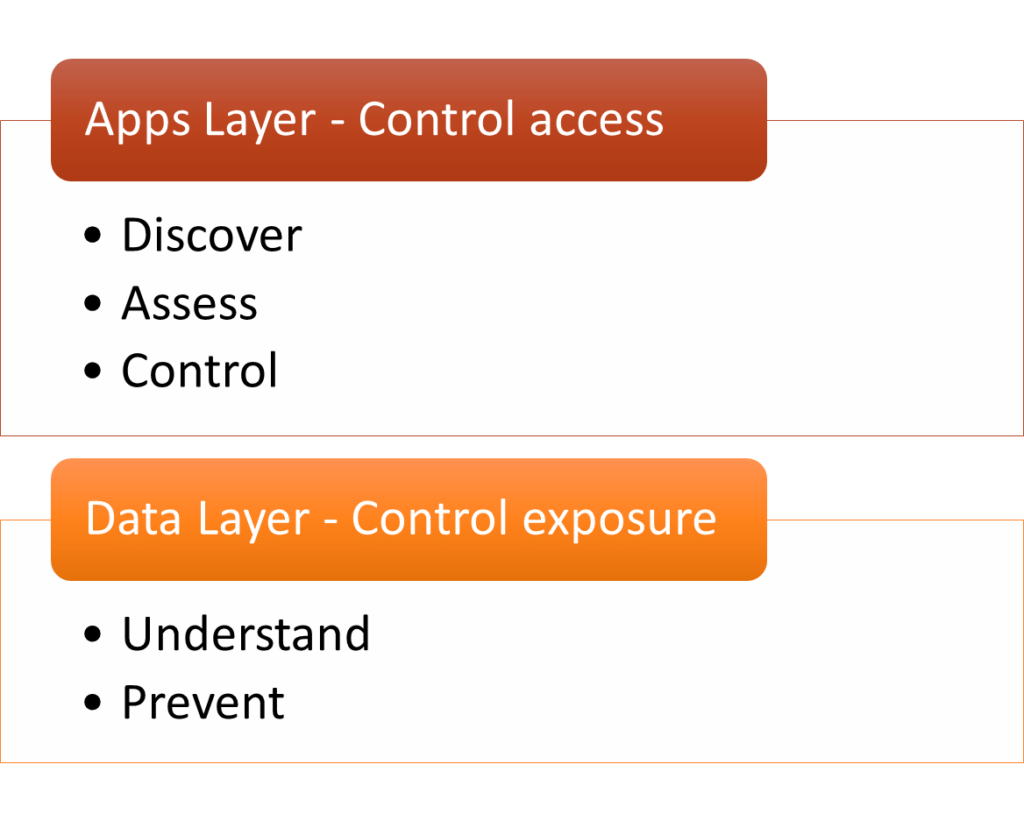
In practice, I simplify it into two core decisions:
Control the apps
Where data is allowed to go
Control the data
What data is allowed to leave
Everything else supports these two controls.
This simplification helps organisations move from fragmented responses to a repeatable governance model.
Not All AI Is Equal
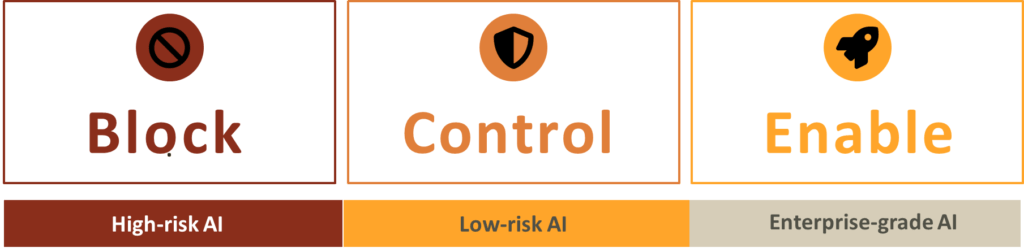
One of the biggest mistakes organisations make is treating every AI tool the same. They are not.
- High-risk AI should be blocked.
- Lower-risk AI may be allowed, but with strong data controls.
- Enterprise AI platforms should be enabled and governed.
The goal is not to block all AI.
It is to apply proportionate controls based on risk.
This is where many strategies fail. They default to restriction instead of control.
Effective governance is not about saying no. It is about deciding where AI can be used safely, and what data can be shared.
You Need Both Controls
If you only control the apps, data can still leak.
If you only control the data, you still lack visibility.
Effective governance requires both:
- Control the apps
- Control the data
Without both, risk remains.
In practice, the data layer is often the most critical. Even if an AI tool is approved, sensitive data should not be shared without protection. This is where Microsoft Purview Data Loss Prevention becomes essential. I walk through this in my guide on Deploying Microsoft Purview DLP for Copilot and Generative AI, including how to prevent sensitive prompts and control data exposure.
Common Mistakes
Across organisations, the same mistakes appear repeatedly.
- Treating all AI tools as equal
- Focusing on blocking instead of understanding usage
- Ignoring the data layer
- Relying on users to make risk decisions
- Starting with policy instead of visibility
These approaches slow down adoption without reducing risk.
What Matters Most
There are five things every organisation should take away.
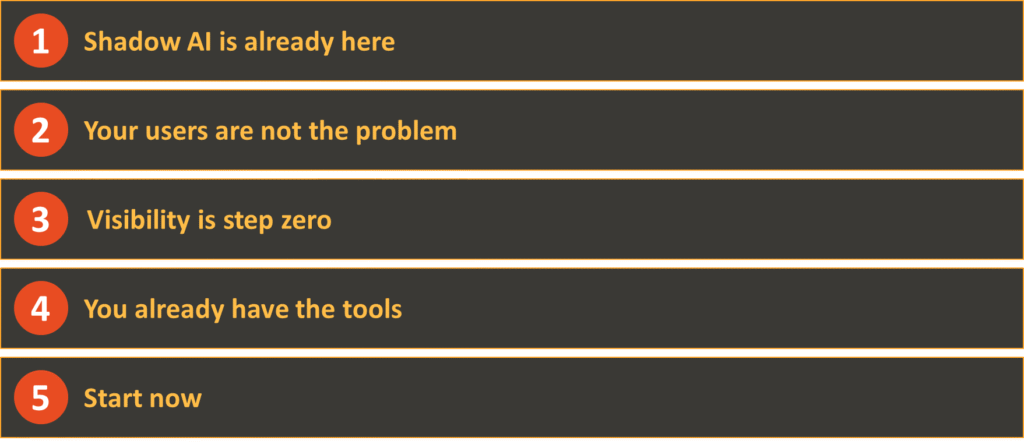
1. Shadow AI is already here
The focus should shift from debate to measurement.
2. Your users are not the problem
They need safe and governed ways to use AI.
3. Visibility is the starting point
If you cannot see it, you cannot control it.
4. You already have the tools
Defender, Purview, Entra and Intune provide a unified control plane.
5. Start now
Progress matters more than perfection.
Final Thought
You cannot stop your users using AI.
But you can control what happens to your data.
The organisations that act now will enable AI safely.
The ones that wait will be reacting to incidents.
Continue to the Implementation Guide
If you are ready to move from understanding Shadow AI risk to actively governing it, the next step is to apply this control model in practice.
In the next article How To Govern Shadow AI Using Microsoft Purview, Defender And DSPM, I break this down into practical, real-world steps using Microsoft Defender, Microsoft Purview, Entra, and Intune:
- How to discover which AI tools are actually being used in your organisation
- How to assess risk and identify which tools should be allowed, controlled, or blocked
- How to protect sensitive data when users interact with both approved and unapproved AI services
- How to enforce controls across endpoints, browsers, and cloud apps
This is where you move from visibility to control, and from insight to enforcement.
Frequently Asked Questions (FAQ)
What is Shadow AI?
Shadow AI is the use of AI tools without the knowledge, approval, or governance of an organisation’s IT or security teams.
This typically involves employees using public or consumer-grade AI services for work tasks, often with company data. The risk is that sensitive information leaves the organisation the moment a prompt is submitted, usually without visibility or control.
Why is Shadow AI a risk?
Shadow AI introduces three immediate risks:
Data leakage as sensitive information is shared outside the organisation
Compliance gaps where regulatory or contractual obligations may be breached
Loss of visibility and control over how data is being used
The challenge is not malicious behaviour. It is that productivity is happening outside governed environments.
Is Microsoft 365 Copilot considered Shadow AI?
No.
Microsoft 365 Copilot is enterprise-grade AI that operates within your Microsoft 365 tenant. It respects your existing permissions model, sensitivity labels, and data loss prevention policies, and activity is auditable.
Shadow AI typically refers to public or unsanctioned tools that operate outside these controls.
How do organisations typically discover Shadow AI?
Most organisations do not discover Shadow AI through a security alert.
It usually starts with a question such as:
“Are people putting sensitive data into AI tools?”
From there, organisations move through a pattern:
Discovering AI usage through visibility tools
Mapping where sensitive data is exposed
Realising the scale of unmanaged risk
Discovery is usually the turning point from assumption to evidence.
Can you stop employees using AI tools?
In practice, no.
Users will continue to adopt tools that help them work faster.
The objective is not to stop AI usage. The objective is to govern it, by:
Providing safe, enterprise alternatives
Reducing risk from unmanaged tools
Controlling what data can be shared
What is the first step in Shadow AI governance?
The first step is visibility.
You need to understand:
Which AI tools are being used
Who is using them
What data may already be exposed
Without visibility, governance decisions are based on assumptions rather than evidence.
What is the best way to control Shadow AI risk?
A practical approach focuses on two core controls:
Control the apps so you decide which AI tools are allowed
Control the data so sensitive information cannot be shared inappropriately
This aligns with Microsoft’s recommended model of discovering, assessing, controlling apps, and controlling data.
What is the biggest mistake organisations make with Shadow AI?
The most common mistake is focusing on blocking rather than understanding and governing.
Other frequent mistakes include:
Treating all AI tools as equal
Ignoring the data layer
Relying on users to manage risk themselves
Starting with policy before visibility
Effective governance starts with understanding how AI is actually being used.
What should organisations do next?
Start simple:
Establish visibility into AI usage
Identify the highest-risk scenarios
Apply proportionate controls
Protect sensitive data
Progress matters more than perfection.
What is Shadow AI governance?
Shadow AI governance is the process of discovering, assessing, and controlling the use of AI tools in an organisation, while protecting sensitive data from being exposed through unmanaged AI interactions.
Need help governing AI and protecting your data in Microsoft 365?
If you’re working through these challenges in your organisation, I can help.
Nikki Chapple is a dual Microsoft MVP (Microsoft 365 and Security) and Principal Cloud Architect at CloudWay, helping enterprises reduce data exposure, prevent data loss, and manage AI risk across Microsoft 365. More about Nikki.
She co-hosts the AI Governance and Data Security Show with Ryan John Murphy, helping organisations securely adopt AI, govern data, and manage generative AI risk.
📺 YouTube · 🎧 Spotify · 🎧 Apple · 🔗 LinkedIn