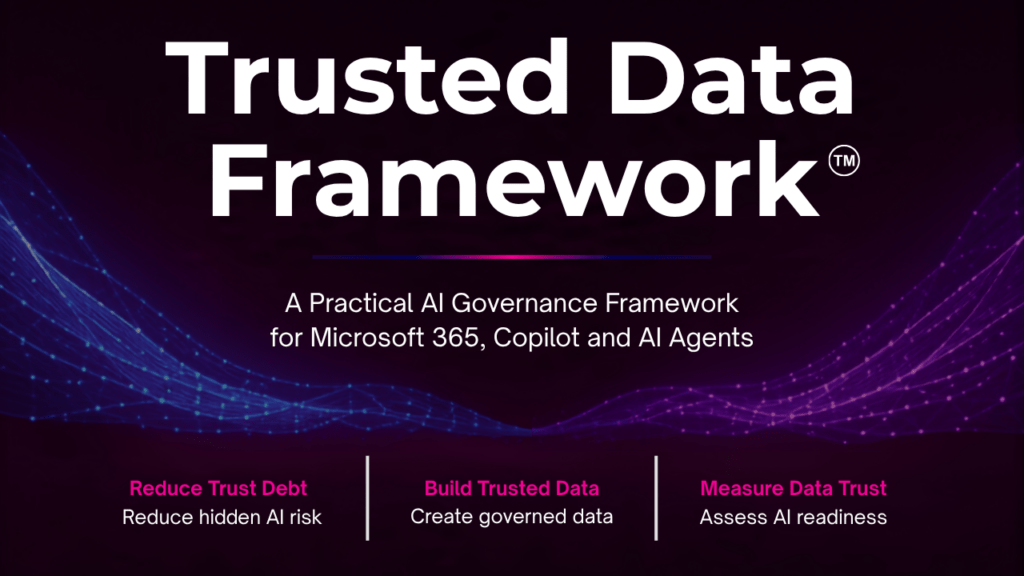
A Practical AI Governance Framework for Microsoft 365, Copilot and AI Agents
Introduction
Organisations are rapidly adopting Microsoft 365 Copilot, AI Agents and generative AI to improve productivity and accelerate innovation. Yet many discover that AI success depends less on the technology itself and more on the quality, governance and trustworthiness of the enterprise data it can access.
Artificial intelligence does not create poor data governance. It exposes it.
Every over-permissioned SharePoint site, unlabelled document, unmanaged workspace and unsecured AI Agent becomes discoverable at the speed of a prompt.
The Trusted Data Framework™ provides a practical methodology for helping organisations reduce Trust Debt, build Trusted Data and measure Data Trust, creating the foundation for secure and responsible AI adoption.
The Trusted Data Journey
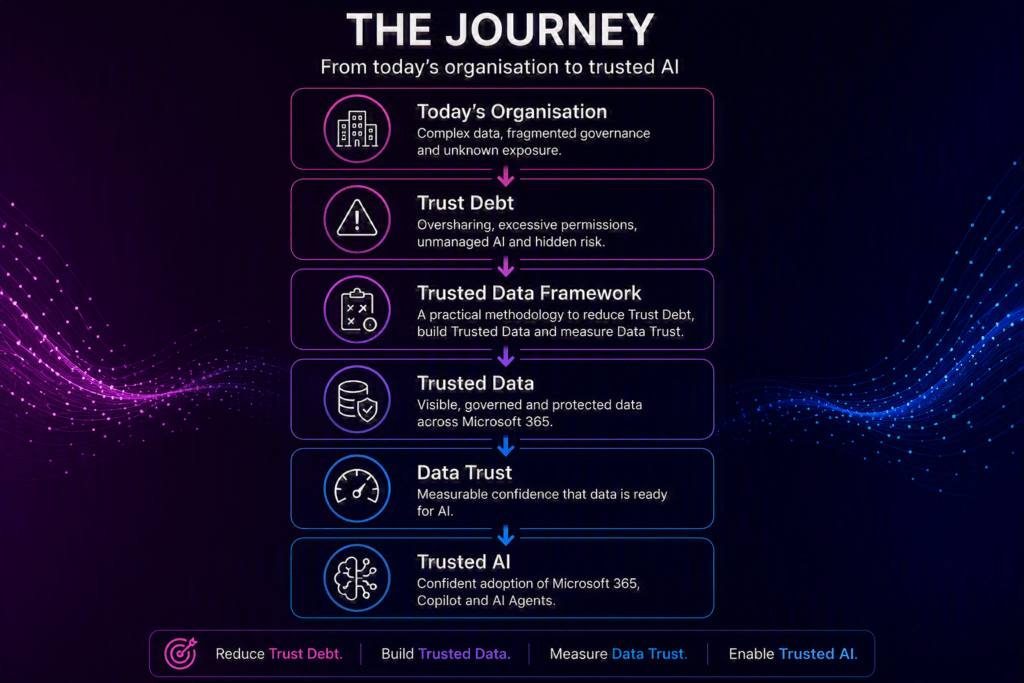
The Trusted Data Framework helps organisations reduce Trust Debt, build Trusted Data and measure Data Trust, creating the foundation for Trusted AI.
Why Trusted Data Matters
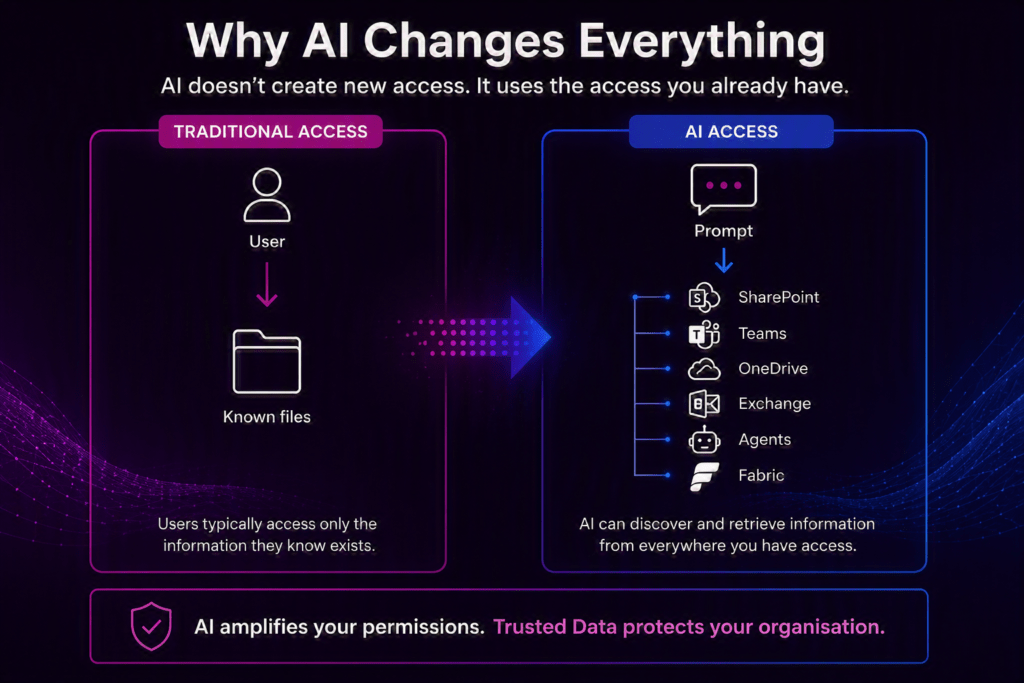
Modern AI operates across existing permissions and enterprise knowledge.
If data is poorly governed, AI amplifies existing weaknesses rather than creating new ones.
Common challenges include:
- Overshared SharePoint and Teams content
- Excessive permissions
- Unclassified sensitive information
- Shadow AI
- Poor visibility of enterprise data
- Limited evidence that governance controls are operating effectively
The challenge is not governing AI in isolation.
The challenge is governing the data AI already knows how to reach.
The Three Core Concepts
Trust Debt™
The governance gaps that accumulate over time and increase organisational risk.
Examples include excessive permissions, oversharing, unmanaged AI usage, poor information governance and missing evidence that security and compliance controls are operating effectively.
Trusted Data™
Enterprise data that is:
- Visible
- Governed
- Supported by measurable evidence
Trusted Data enables organisations to adopt Microsoft 365 Copilot and AI Agents with confidence.
Data Trust™
The measurable confidence that enterprise data is ready for AI.
As Visibility, Governance and Evidence improve, organisations increase Data Trust and reduce Trust Debt.
You build Trusted Data to earn Data Trust.
What Makes This Different?
Many AI governance approaches focus on policies, councils, risk assessments and compliance requirements.
The Trusted Data Framework takes a different approach.
Rather than starting with AI itself, it starts with the foundation AI depends on:
- The quality of enterprise data
- The governance of that data
- The evidence that controls are operating effectively
By reducing Trust Debt, building Trusted Data and measuring Data Trust, organisations create the conditions required for secure, governed and trustworthy AI.
The result is a practical methodology that connects business strategy, operational governance and measurable assurance across Microsoft 365, Copilot and AI Agents.
The Trusted Data Framework™
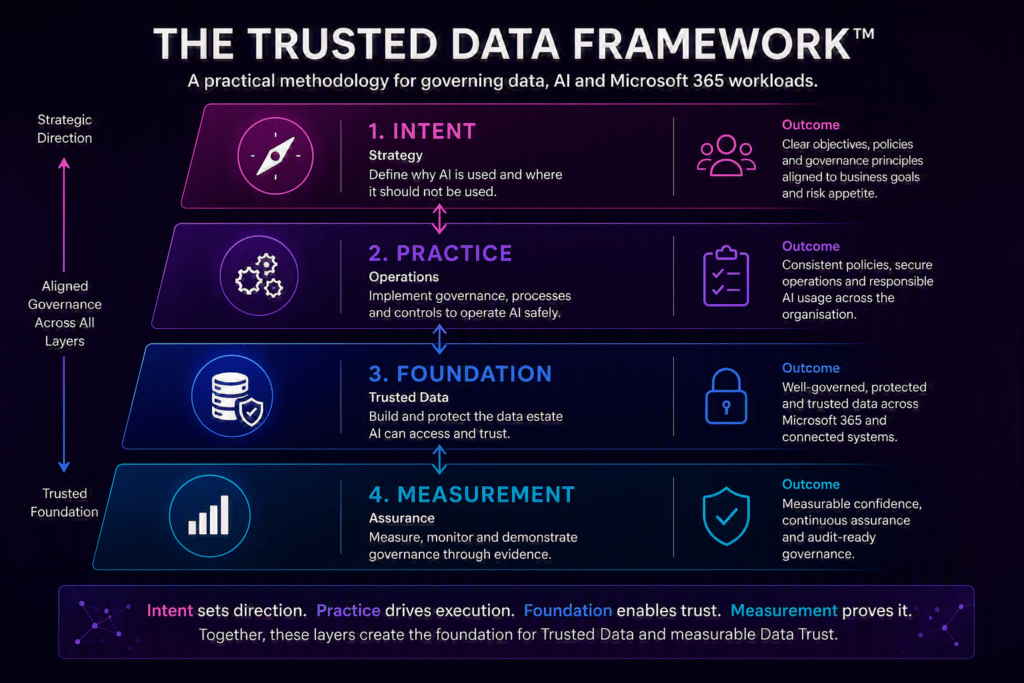
The framework connects business objectives with operational governance through four interconnected layers.
| Layer | Purpose |
|---|---|
| Intent | Define why AI is being used and establish governance principles. |
| Practice | Implement governance policies, operational processes and security controls. |
| Foundation | Build Trusted Data across Microsoft 365. |
| Measurement | Demonstrate governance through measurable evidence and assurance. |
Rather than treating governance as a one-off project, the framework supports continuous improvement as AI capabilities evolve.
Measuring Data Trust
At the heart of the framework is a simple model.
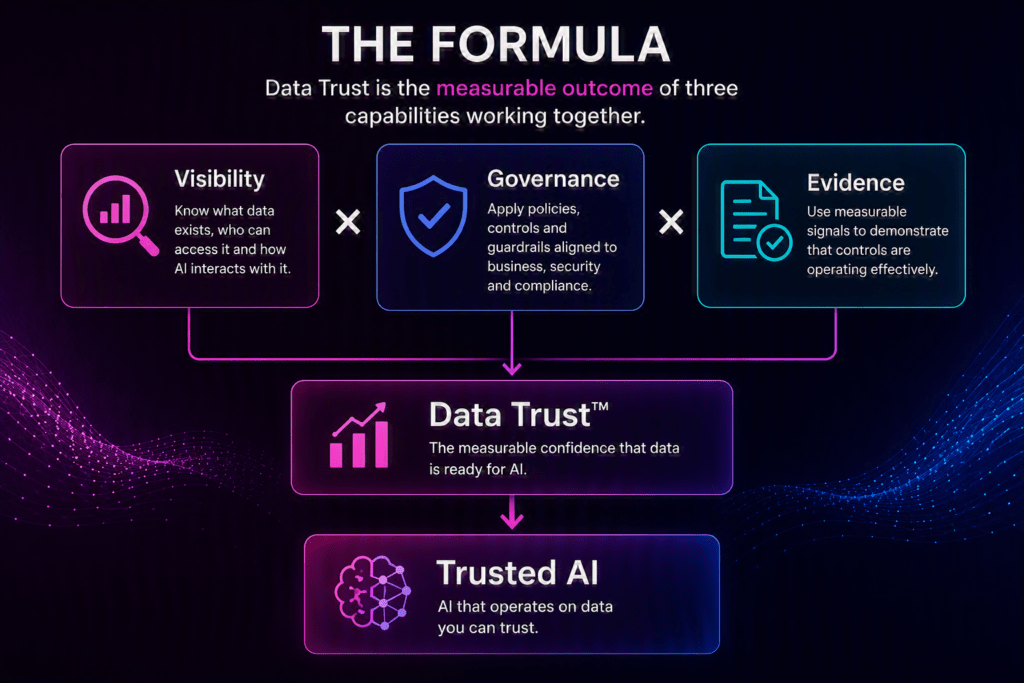
Data Trust = Visibility × Governance × Evidence
Data Trust is not based on opinion or assumptions. It is the measurable outcome of three interconnected capabilities working together.
Visibility
Visibility ensures organisations understand their data estate.
This includes understanding:
- What data exists
- Where it resides
- Who can access it
- How AI can interact with it
Governance
Governance ensures information is protected appropriately.
This includes:
- Information protection
- Permissions management
- Lifecycle controls
- AI governance policies
- Regulatory compliance
Evidence
Evidence demonstrates that governance is operating effectively.
Reporting, audit, monitoring and measurable outcomes provide assurance that controls are working as intended.
Because these capabilities are interdependent, weaknesses in one area reduce overall confidence in enterprise data.
Trusted AI depends on all three.
The Operational Model
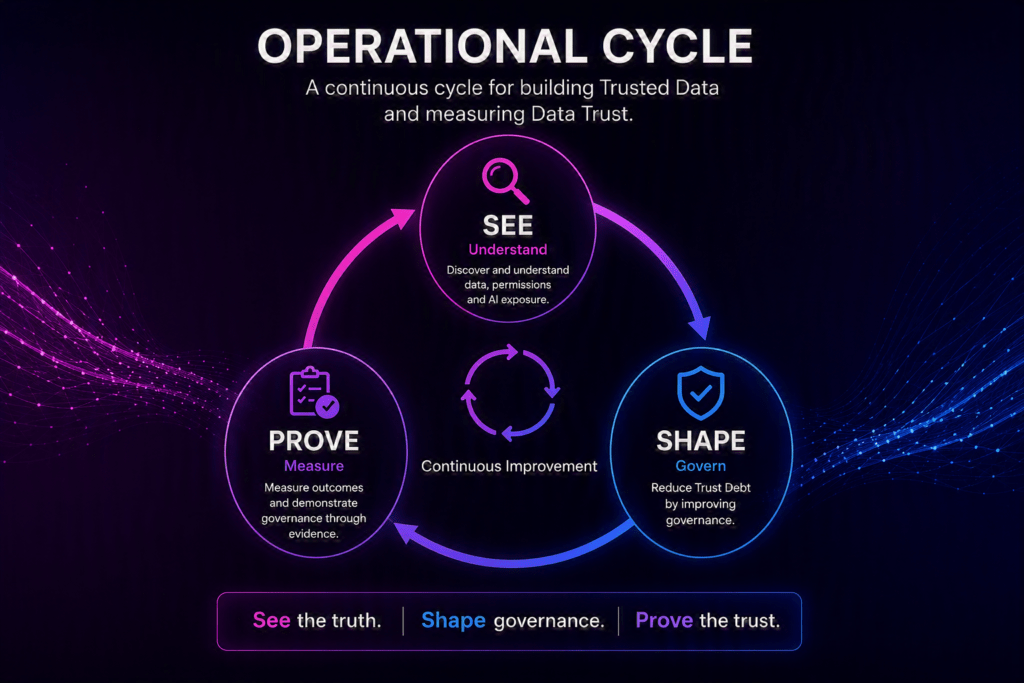
The framework is implemented through a continuous governance cycle.
See
Discover and understand data, permissions and AI exposure.
Shape
Reduce Trust Debt by improving governance.
Prove
Measure outcomes and demonstrate governance through evidence.
As organisations repeat this cycle, they continuously improve Data Trust and strengthen AI readiness.
Who Should Use the Trusted Data Framework?
The framework is designed for organisations adopting Microsoft 365 Copilot, AI Agents and generative AI, including:
- CIOs
- CISOs
- Data Governance Leaders
- Microsoft 365 Architects
- Compliance and Risk Teams
- AI Governance Councils
- Security and Compliance Programmes
Expected Outcomes
Organisations adopting the Trusted Data Framework can:
- Reduce Trust Debt across Microsoft 365.
- Improve governance for Microsoft 365 Copilot and AI Agents.
- Strengthen data security and regulatory compliance.
- Increase confidence in AI-generated outcomes.
- Demonstrate governance through measurable evidence.
- Build a scalable foundation for future AI initiatives.
Most importantly, organisations replace reactive governance with a continuous process that builds Trusted Data, reduces Trust Debt and increases Data Trust over time.
Explore the Framework
This page introduces the Trusted Data Framework. Each component is explored in greater depth throughout the site. (Coming soon)
- Trust Debt – Understanding hidden governance risk.
- Trusted Data – Building enterprise data that AI can trust.
- Data Trust – Measuring AI readiness through evidence.
- Visibility – Discovering and understanding enterprise data.
- Governance – Applying protection, permissions and lifecycle controls.
- Evidence – Demonstrating assurance through reporting and audit.
- See • Shape • Prove – The operational governance model.
- Microsoft Implementation – Applying the framework using Microsoft Purview, Entra, Defender, Fabric and Microsoft 365.
Trusted AI Starts with Trusted Data
Artificial intelligence is only as trustworthy as the data it can access.
The Trusted Data Framework provides a practical methodology for reducing Trust Debt, building Trusted Data and measuring Data Trust, enabling organisations to adopt Microsoft 365 Copilot and AI Agents with confidence.
Reduce Trust Debt. Build Trusted Data. Measure Data Trust.
Trust Debt is the risk to reduce.
Trusted Data provides the foundation.
Data Trust provides the measurement.
The Trusted Data Framework provides the methodology.
The Trusted Data Framework™ is an original methodology developed by Nikki Chapple for governing enterprise data, Microsoft 365 and AI.